 English
 Español
It's approaching a year since the Denver Nuggets fired Calvin Booth and Michael Malone on the same day. It was a stunning move that ended the tenures of the GM and coach who delivered the franchise its first championship just two years earlier.
The two clashed over how to build a roster after the title. Malone wanted veterans. Booth wanted to develop young players. They didn’t see eye to eye. They talked behind each other’s backs. And Nuggets president Josh Kroenke had enough of the tension consuming the organization.
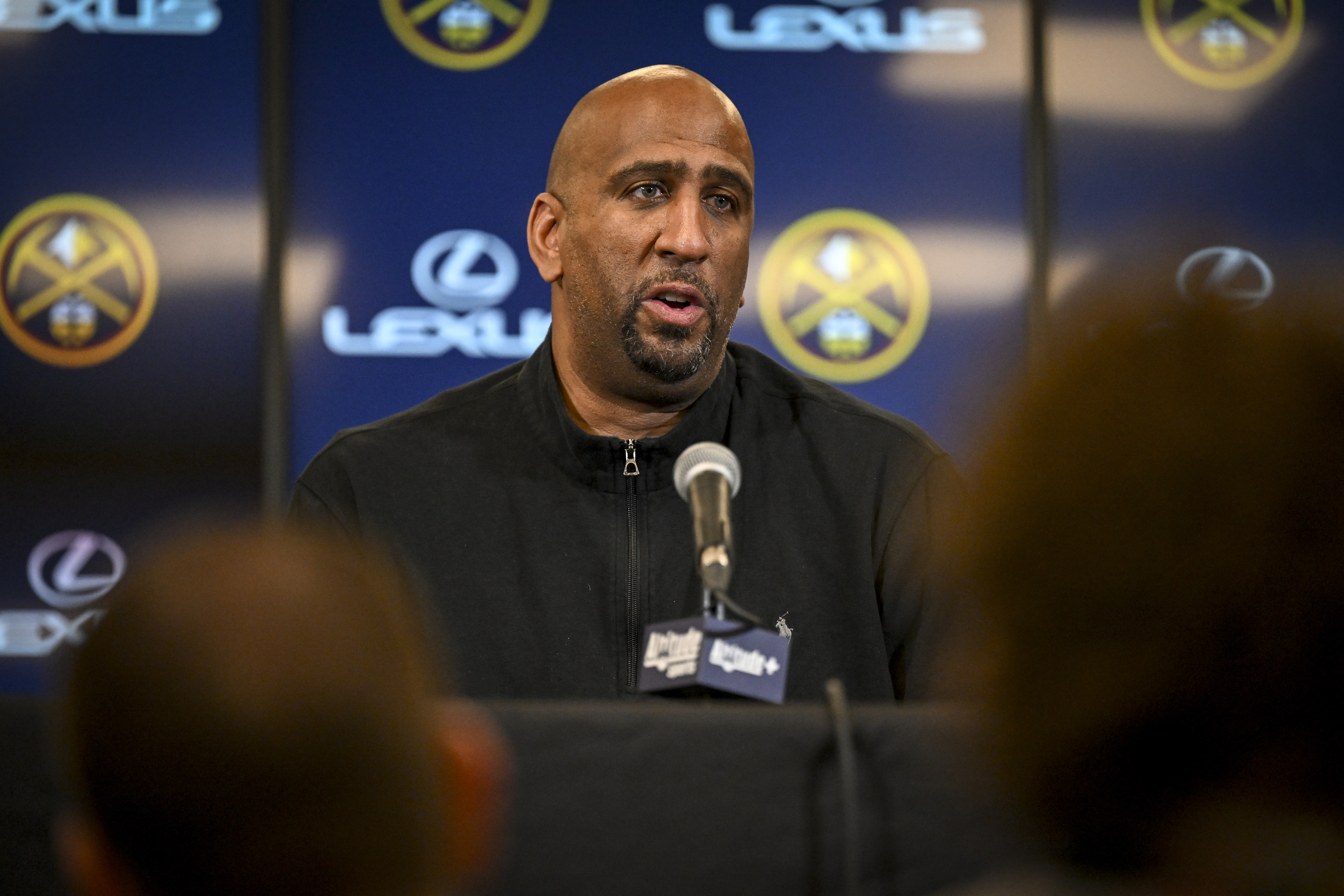
“I think we both would admit a lot of stuff is overblown,” Booth said on The Kevin O’Connor Show in an illuminating conversation that shows an ex-GM still processing what happened, still proud of what he built, and still waiting on the phone to ring.
In the time since, Booth has been consulting with college basketball programs and Malone has been working as an analyst for ESPN. Neither has landed another NBA job.
“He doesn’t mind commentating games,” Booth said. “But he would probably die to coach an NBA team tomorrow. And he deserves it. He’s a championship coach.”
Booth didn’t want to conduct an "autopsy" of the day he and Malone got fired, but when I asked what he was told, it’s clear that one detail still stings: The organization told him they didn't want there to be a "winner or loser" in the situation between him and Malone.
"When you say a winner or loser, that's a reference to a game," he said, his voice shifting. "It's not a game to me. It's my life."
Booth believes four factors converged to cost him his job. First, the Nikola Jokić effect: when you have the best player in the world, everything else gets taken for granted. Second, the friction between a tenured champion coach and a first-time GM. Third, ownership. Booth believes the Kroenke family, for all its success across sports, doesn't place the same value on front-office executives that other organizations do.
"Whether it's Mark Warkentien or Tim [Connelly] or Masai [Ujiri], there's always gonna come a point where they don't value executives like that," he said of former Nuggets executives. "I'll probably disagree with their take on executives, but who am I? They've been so successful, so maybe it's the right way to operate.”
And fourth: “I think I just made it look too easy.”
He elaborated: "Anybody that's really good at something, when they make it look easy, that was really, really hard to get to. [It took] a lifetime's worth of playing basketball, coaching basketball, having conversations, scouting. For me to go in there right away, assemble a championship team, win a championship.”
In his first offseason as the lead decision-maker after Connelly left for a more lucrative job with the Minnesota Timberwolves in 2022, Booth traded Will Barton and Monte Morris for Kentavious Caldwell-Pope. He signed Bruce Brown. He drafted Christian Braun with the 21st pick and aggressively traded up to select Peyton Watson 30th. He traded Bones Hyland to create minutes for Braun. The result: a 16-4 playoff run and the franchise's first title.
“We won a championship. There was definitely alignment,” Booth said.
Then the parade ended. And the decisions that would define Booth's narrative and eventually cost him his job began. Brown signed with Indiana, and Jeff Green got a better offer in Houston. The next summer, KCP left for Orlando. Booth signed a few veterans, including Russell Westbrook, Dario Šarić, and Justin Holiday. But his primary focus was on drafting young players to someday replenish what was lost in the rotation.
"You have a headache, right?" Booth said. "You want to take a Tylenol to get rid of the headache, but it makes you drowsy. Do you want to get rid of the headache or not? Because if you want to get rid of the headache, you have to take the whole pill. You cannot separate Peyton Watson and Christian Braun from some of the other things that people weren't happy with."
To Booth, the drowsiness was worth it. Braun immediately contributed as a rookie, but the others didn’t. Watson was raw coming in and didn’t really break out until last season. And this year, with the Nuggets being ravaged by injuries to star veterans Jokić and Aaron Gordon, Watson has looked like a potential star. Executives around the NBA think Watson could sign for roughly $25 million annually or more when he hits free agency this offseason.
“The reality of the thing is if we sign Bruce Brown back, we sign KCP back, or if they leave and we sign veterans … do Christian Braun and Peyton Watson do what they're doing right now?” Booth said. “Definitely not.”
Booth had a plan to build a sustainable winner. In 2022, Booth drafted Braun and Watson. In 2023, he drafted Julian Strawther (29th), Jalen Pickett (32nd) and Hunter Tyson (37th), and signed Collin Gillespie as an undrafted free agent. In 2024, he drafted DaRon Holmes (22nd) and signed Spencer Jones to a two-way deal.
Strawther, Pickett and Jones have all played key roles in keeping Denver afloat with so many absences. In addition to Jokić and Gordon missing time, Braun and Watson have been hampered by injuries, too. Meanwhile, Gillespie has turned into a starting point guard and helped change the culture of the Phoenix Suns. For a group of late firsts, seconds and undrafted choices, it’s quite a strong stretch of successful choices.
“In most situations when somebody's running a team, I don't think the expectation is to bat 1.000,” Booth said. “For some reason, I started to get the feeling that that was the expectation for me from whoever was in and around the Denver Nuggets community.”
Booth pushed back on the idea that going young was purely a philosophical choice. Denver's ownership wasn't absorbing a massive tax bill, so he needed a pipeline of cheap contracts. And in the portion of the draft where Denver was picking, the value wasn't in one-and-done talents the whole league had passed on, like Watson. It was in older players, discounted for superficial reasons. Pickett's game wasn't pretty. Gillespie was undersized and unathletic. Those were features, not bugs.
“One of the things that is slightly annoying is how everybody constantly tries to place a ceiling on different guys,” Booth said. “When Jimmy Butler goes 30th, does anybody know he's going to be Jimmy Butler? Or Fred VanVleet's undrafted, does anybody know he's gonna be Fred VanVleet? So I just think you try to get a player you think is going to be good and you just see what happens. I don't think you're ever going to know what somebody's true ceiling is.”
If Booth was graded purely on his transactions, he’d still have his job. For all the debate about roster construction, the tension that ultimately sank Booth's tenure was with Malone. Reports of friction leaked for years. When both were fired on the same day, it seemed like confirmation that the rift had become untenable.
"Never a physical altercation in front of people. Never a verbal altercation in front of people," he said. "So where's the beef?"
When I noted that it's not common for a GM and a coach to be fired on the same day, Booth acknowledged friction existed but framed it as inherent to the job, not unique to Denver. “How many teams do you think that's happened with currently?" he asked. “I don't think it's unique to our situation. I think it happens with every team at some level in the NBA.”
Booth credited Malone with developing Watson and Braun. He said the championship required alignment between them. He said Malone deserves another head-coaching job. But he was also honest about the bind he was in. Former NBA GM and coach Flip Saunders, Booth said, used to talk about the difference between idealistic and realistic. Front offices are idealistic. Coaches are dealing with reality every day: the pressure, the decisions, the knowledge that a losing streak could end their career. Booth admitted he was probably too idealistic in expecting a coach under that kind of pressure to execute a long-term development plan, especially for a first-time GM without a track record.
“I have to take accountability whatever way that narrative grew legs and my part in it, I've learned from that,” Booth said. “There's such a weird paradox with NBA coaches. They're in the midst of the lion's den. They're dealing with players, some of the most formidable size-wise and ego-wise in the world, and they're managing them. Those guys buy in. And then these coaches have to report to a general manager who maybe doesn't have the gravitas they do. I just think it's a human nature thing.”
Even with that awareness, Booth doesn't think the outcome was a reflection of how he handled it. He thinks he managed it better than most would have.
"You could put 100 GMs in my position," he said. "I don't know what, three or four of them do as good as I did."
Still, understanding the problem and solving it are different things.
"When I get that title, it's not an option for me not to do my job," Booth said. "So I think one of the only outcomes where everybody thinks we're aligned is me submit, lay down, not do the job. And that's not an option for me. So some version of this was going to happen. Could have been quieter. Could have not grown legs with the media. Could have not been such a crawl in ownership's pants. Maybe there's some different things that could happen in that regard.”
Since Booth's departure, the Nuggets' new front office led by Ben Tenzer and Jon Wallace traded Michael Porter Jr. for Cam Johnson, re-acquired Bruce Brown, and added Jonas Valančiūnas and Tim Hardaway Jr. When I asked Booth what he thought, he didn't flinch.
"They're great. A lot of them we talked about when I was there. We thought we were gonna get Valančiūnas at the trade deadline,” Booth said. “Obviously, they did their own unique things, but the one thing about the new CBA, there's only so many trades that can be done. It's kind of like paint-by-numbers, in that sense. So anybody sitting in that seat in Denver is going to have some kind of Michael Porter Jr.-for-Cam Johnson concept, because that's just one of the better deals that was out there.”
Right now, Booth is consulting with college programs, helping coaches navigate the transfer portal. But when I asked if he wanted to run an NBA team again, the measured answer couldn't quite hide the want underneath it.
"Nobody's entitled or owed an opportunity to run an NBA team. There's 30 jobs. All those guys in their own way deserve to be in that seat," he said. "I'd be foolish to say that for the right scenario I wouldn't be willing to work for somebody."
Booth built a championship team, drafted a pipeline of players now contributing across the league, and left behind a roster framework that another front office executed. Booth said not a single owner has called.
“My door wasn't knocking down with people waiting to hire me. That's where this whole thing got blown out of proportion,” Booth said. “If you look tangibly at what I did — my win percentage, what I drafted, working with a coach like Coach Malone as a first-time GM — I just don't know how my door isn't knocking."
My full conversation with Calvin Booth goes deeper into his time with the Nuggets, Jokić, his basketball philosophy, the upcoming draft, and many more subjects. Check it out on the latest episode of The Kevin O’Connor Show.