 English
 Indian
 العربية
 Español
 Deutsch
 Türkçe
 Русский
 Français (Afrique)

Asian Games: Wrestlers Antim Panghal, Manisha Bhanwala advance to quarters; Deepak Punia enters semifinals
Aichi-Nagoya [Japan], October 3 (ANI): Indian wrestlers Antim Panghal and Manisha Bhanwala advanced to the quarterfinals while Deepak Punia progressed to the semifinals at the Asian Games 2026 on Saturday, continuing India’s strong run in the wrestling competition. truewildslot.com
Antim made a dominant start to her women’s 53kg campaign, defeating Kazakhstan’s Shugyla Omirbek 9-0 in the pre-quarterfinals to book her place in the last eight.
Manisha also produced a commanding performance in the women’s 57kg category, defeating South Korea’s Kwon Youngjin 8-0 by fall in her pre-quarterfinal bout. She will face Japan’s Akari Fujinami in the quarterfinals.
Deepak, competing in the men’s freestyle 97kg category, initially defeated China’s Zhou Junpeng 10-2 by technical superiority in the pre-quarterfinals. He led 6-2 after the opening period before completing the victory with a 6-0 second period.
The Indian then advanced to the semifinals after his scheduled quarterfinal opponent, Hong Kong China’s Li Vincent, forfeited the bout.
Sagar Jaglan also moved into the quarterfinals of the men’s freestyle 74kg category after defeating Mongolia’s Tulga Tumur-Ochir 8-1 in the pre-quarterfinals.
In other action, India’s women’s rugby sevens team defeated Singapore 22-5 in their first classification match and will face Kazakhstan in their next 5th-8th place encounter.
India’s campaign in taekwondo ended without a win as Kashish Malik and Jyoti Yadav suffered opening-round defeats. Kashish lost 0-2 to reigning Olympic champion Kim Yujin of South Korea in the women’s 57kg round of 16, while Jyoti went down 0-2 to Thailand’s Kannaluck Chuenchooklin in the women’s 67kg round of 16.
Earlier in the day, 17-year-old Kumkum Mohod scripted history by winning gold in the women’s individual recurve archery event. She defeated South Korea’s Oh Yejin in a shoot-off after the final was tied 5-5.
Golf also remained a medal prospect for India, with Pranavi Urs returning to the lead in the women’s individual stroke play. She moved to 15-under after a birdie on the 13th hole and held a one-stroke advantage over China’s Yin Ruoning with five holes remaining.
India’s medal tally has reached 77, including 17 gold, 25 silver and 35 bronze medals, at the time of writing. (ANI)
(This content is sourced from a syndicated feed and is published as received. The Tribune assumes no responsibility or liability for its accuracy, completeness, or content.)
“The Fact That We Don’t Have to Go Through Those Stressful Qualification Moments Is a Very Good Feeling”: Sjoerd Marijne on LA28

You spoke about creating unity, discipline and a strong team culture. How difficult was it to bring the players together and make them believe in these values?
Sjoerd Marijne: Thank you for the compliments. But it is not just me. The whole staff has played an important role, and I have a very good staff.
The first step was creating unity. We discussed what behaviour and culture we wanted in the team and what culture we had in the past. We brought that culture back. Discipline is a very important part of it, but enjoyment and having fun are also important.
Most importantly, I believe in focusing on team goals. Sometimes individuals focus only on themselves, and then they may not achieve their goals. Focusing on the team’s goals helps you achieve your individual goals. These are some of the things we have accomplished together with the staff.
India were often criticised for lacking mental strength, especially against strong teams like China in high-pressure matches. The penalty stroke save in the final showed how well the team handled pressure. How did you prepare the players mentally for that match?
Marijne: You always have to look at your key performance indicators. One of them is defending really well, and that is what we saw at the World Cup. We also saw how Argentina beat the Netherlands in the final by defending well.
That is the first thing we need to do properly, and it requires running and hard work. I think we did that really well in the final. When you defend well, it becomes very difficult for the opposition to score.
At the same time, when you get an opportunity, you have to finish it. That is what we did. It was a beautiful moment for Sharmila in her 200th international appearance.
We also have the quality of players like Savita, who can make important saves. At the World Cup, we saw another great save from our goalkeeper.
It is about individuals showing their skills and talent at the right moments while remaining part of the team. We also have young players who played at the World Cup and the Asian Games.
It is a good mix of talented players. The senior players take the lead, take ownership and set an example. The juniors are disciplined. That is how we have recreated a unit in which everybody understands their responsibilities.
For us, the final was like an examination. We had spent the whole year studying and playing matches, and now it was time for the test. I told the girls that we had to be prepared, and we passed that test because we were very well prepared.
In the semi-final against Korea, India had eight penalty corners but could not convert them initially. How do you prepare the team to adapt when Plan A does not work and find other ways to score?
Marijne: We are constantly working on different plans. In the final, for example, if the match had remained level with only a few minutes left, our Plan B was to take it to the shootouts. We are very confident in our shootouts.
That was one example of our Plan B. During the tournament, we also created a lot of chances. When you are one goal behind, you know you need to create more, and we worked on those situations as well.
We don’t just have Plan A and Plan B. We also have Plans C and D. The staff and I are constantly working on these plans to prepare the players. We have different ways of dealing with pressure. If one approach does not work, we move to another.
When we spoke in the Netherlands during the World Cup, you said you wanted about a year and a half to prepare for the Olympics. You said winning the Asian Games gold would give you that opportunity. Now India has won gold and qualified for LA28. How important is this preparation time?
Marijne: It is no longer about asking what if. It is going to happen.
Normally, if we had not qualified, we would have had to prepare for the qualification matches in March 2028. If we qualified, we could continue with the next steps.
Now we do not have to think about whether we will qualify. All the plans we are making and all our preparation are focused on LA28.
The Netherlands and the host country are the only teams that already know they will be at the Olympics. The rest of the world still has to fight for their places.
The fact that we do not have to go through those stressful qualification moments anymore is a very good feeling. Now we will evaluate the final, look at what we can improve and continue working towards Los Angeles.
Was introducing new players and creating competition within the squad a conscious plan? Did the Hockey India League play a role in your vision?
Marijne: Absolutely. I believe competition makes players better. It is not always nice for the players, but if they feel too safe, they will not improve.
We constantly push them outside their comfort zones. That is part of being an athlete.
Young players bring new energy to the team. We have introduced some new and young players, but they also understand that they need to be very disciplined if they want to come into the team.
As long as they continue to work hard, they can make mistakes. That happened in the final as well. The important thing is to keep working hard and learning.
Shilpi Dabas’ journey is particularly interesting. She was not part of the camp for a long time and initially did not get an opportunity, but you eventually selected her, and she has gone on to make a big impact. What did you see in Shilpi that made you believe she deserved that opportunity, and what convinced you that she could succeed at this level?
Marijne: I cannot speak about the period before I joined because I was not part of that process, and I do not like talking about the previous coach.
I saw Shilpi and spoke to her Hockey India League coach, Sophie Geerts. I watched her timing and felt she had the qualities needed to defend. I invited her to the camp, and she arrived on the morning of the trials.
She has good timing as a defender. The first thing a defender needs to do is defend well. After that, other aspects of the game can develop.
She has a good high ball and a hard slap. She needed time to adjust from domestic hockey to the international level, but she did really well.
I do not think she would have imagined in January that, by the end of the year, she would be part of a team that finished fifth at the World Cup and won Asian Games gold.
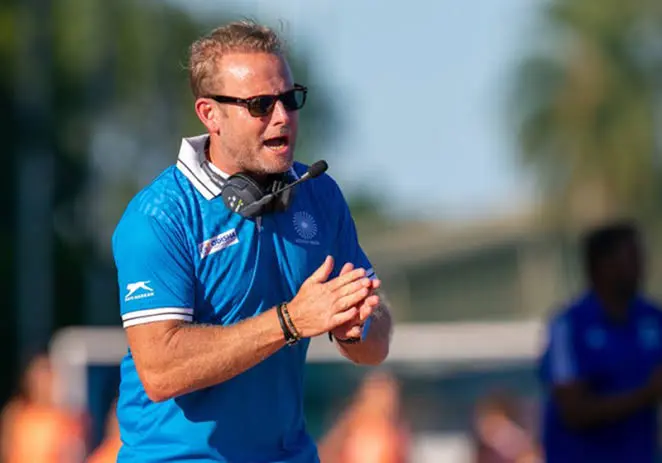
Do you believe her journey can inspire more young Indian girls to take up hockey and believe that if they have the talent, they too can get an opportunity to represent India?
Marijne: That is exactly what we are trying to do. It is also what happened with the Olympics in 2021. These achievements inspire people.
There is something bigger than winning a gold medal, and that is creating a legacy. That is what the girls have done this year.
They will always be remembered. They will receive prize money and rewards for winning the gold medal, but being remembered for the rest of their lives is one of the biggest achievements they can have.
I am very happy for the girls and the staff.
After the Asian Games gold and LA28 qualification, do you feel Indian hockey is back on track, and is there enough time to prepare for the Olympics?
Marijne: We have more time now, and I think we have more depth in the squad. Those are positive things, but we still have many steps to take.
We are doing really well defensively, but we need to improve our ball possession and create more chances. That will take time.
I am happy that we have the Pro League because we will play against all the strong countries. Playing those matches will help us in our preparation and development.
You were given a clear task when you joined in January. After World Cup qualification, a fifth-place finish at the World Cup and Asian Games gold, how do you look back at your first year as coach?
Marijne: This year has been amazing. What I remember most about this year is the enjoyment with the team and the staff. I am enjoying what I am doing.
The enjoyment comes because we all work hard, but we also know when we can have fun together. That is what I remember most about our victories.
Personally, I do not spend much time thinking about my career. What makes me very happy is seeing the emotions of people in India and how happy they are about what we have achieved.
My phone has been filled with messages on social media and personal apps from people telling me how emotional they have been, with some even crying. Knowing that we have helped people experience these emotions makes me very happy.
(Transcribed by Shourjyani Chatterjee)
Follow REVSPORTZ for more articles,
The post “The Fact That We Don’t Have to Go Through Those Stressful Qualification Moments Is a Very Good Feeling”: Sjoerd Marijne on LA28 appeared first on Sports News Portal | Revsportz.
Abhishek Sharma departs after fifty; Team India reach 114 runs in 10 overs
In the Asian Games 2026 final against Pakistan, Team India has reached the score of 114 runs for the loss of three wickets in 10 overs at the Aichi Prefectural Korogi Sports Park in Nisshin.
Having opted to bat first, Team India's opening batsman Vaibhav Sooryavanshi was dismissed on 15 runs in nine balls, including two maximums. Fellow opening batsman Abhishek Sharma returned to the pavilion after scoring 61 runs in 28 balls, including three boundaries and seven maximums. Wicketkeeper-batsman Sanju Samson departed on two runs in four balls.
Skipper Shreyas Iyer and Ishan Kishan are unbeaten at the crease.
Pakistan's Saim Ayub, Arafat Minhas, and Ahmed Daniyal have claimed one wicket each. Saad Masood, Sufiyan Muqeem, and Abrar Ahmed will continue their hunt for the first scalp.
Earlier, Team India's skipper Shreyas Iyer won the toss and elected to bat first.
Team India's in-form batsman Ishan Kishan said, "Representing India isn't just about being associated with the BCCI, it's always about something much bigger. There are so many expectations, so many plans in motion, and millions of people cheering for you. You feel that intense pride inside, even if you don't always show it externally. It really is a unique feeling. Even though we have a world-class squad with fantastic batters and bowlers, there is still that extra weight of pressure whenever you perform for the country. Cricket can change in an instant, you step out to bat, face one good ball, and the entire momentum of the match shifts. You have to be completely switched on, read the pitch, know what the team requires, and execute your plan. Especially on these kinds of surfaces, prioritising team goals over individual milestones is essential, and that's where our entire focus lies. It’s been a fantastic experience here overall. The local people have been incredibly warm and helpful, guiding us wherever we need to go, even despite the language barrier. When you're in a foreign country, seeing locals go out of their way to support you when it isn't even their job means a lot to us".
"As for the fans, sabse achha cheez yeh hai (the best part is) that no matter where we play around the world, Indian supporters show up in huge numbers and give us that extra cushion of backing. It feels like we start every game with a slight upper hand because of them. I'm deeply grateful to everyone who travels long distances to support us. Win or lose, their love is unconditional, they just want to cheer us on, keep us motivated, and ensure every player feels comfortable. That support truly means everything to us," he added.
Asian Games 2026, IND vs PAK: Confirmed Playing XIs
India: Vaibhav Sooryavanshi, Abhishek Sharma, Sanju Samson (WK), Shreyas Iyer (C), Ishan Kishan, Tilak Varma, Shivam Dube, Axar Patel, Washington Sundar, Ravi Bishnoi, Jasprit Bumrah.
Pakistan: Sufiyan Muqeem, Hasan Nawaz, Abrar Ahmed, Abdul Samad, Saad Masood, Sahibzada Farhan (C), Saim Ayub, Ahmed Daniyal, Usman Khan (WK), Arafat Minhas, Maaz Sadaqat.
CCI reclaim Kanga League crown after 35 years
The Dr HD Kanga Cricket League’s matches on Friday witnessed intense competition in Division ‘A’, with Cricket Club of India (CCI) emerging champions after securing a better quotient (2.228) than Parsee Gymkhana (1.999). Both teams finished with 15 points from six matches.
After CCI’s in-form left-arm spinner Dhrumil Matkar (5-51) and pacer Irfan Umair (3-15) helped restrict hosts MIG CC to 131, opener Akhil Herwadkar’s 45 and Akash Parkar’s unbeaten 27 saw CCI declare at 132-4, earning a crucial first-innings lead and three points. At stumps, MIG were 9-1 in their second innings.
This is CCI’s fifth Kanga League title and first since 1991, when India’s 1983 World Cup-winning captain Sandeep Patil led their triumph. “It’s massive to learn that Sandeep sir, who is our Mumbai team mentor, led CCI to the Kanga League title previously. As CCI captain, it feels great to emulate his achievement. In the last few games, Dhrumil has been in very good rhythm and we were confident that he would give us wickets,” CCI skipper Akash Anand told mid-day.
CCI vice-chairman Mayank Kahandwala, who was part of the 1991 team, said: “History has repeated itself after nearly 35 years. I was fortunate to be a part of that Kanga League-winning team in 1991. Coming from behind to get outright victories in their last two matches is a great achievement by this CCI team.”
At Parsee Gymkhana, Aditya Tare’s 65-ball 84 helped the hosts declare at 241-9. Karnatak SC were bowled out for 235, with Siddhesh Gavande scoring 92. Left-arm spinner Harikesh Yadav claimed 7-84. “A couple of dropped chances didn’t let us win this game by a big margin of 80-90 runs. That would have helped us go ahead on quotient,” Parsee Gym head coach Vinayak Mane told mid-day.
Sanjay Manjrekar backs Ishan Kishan ahead of clash against Pakistan
Former India batter Sanjay Manjrekar reckons the Shreyas Iyer-led Indian team will stick to its attacking batting template despite the tricky pitch conditions in Saturday’s Asian Games gold-medal clash against Pakistan.
“If you look at India’s last game [vs Sri Lanka], there were only two batters who fired — Vaibhav [Sooryavanshi] and Ishan [Kishan]. Both scored at [a strike rate of] 180 and 173 respectively. India will continue to bat that way and we might be disappointed with the way some batters get out. But you have to commit yourself to a template unless you’re chasing. Shreyas will mould his game slightly because this is not your typical T20 flat pitch. I don’t think they’re going to abandon their aggressive approach because of a tricky pitch,” Manjrekar told mid-day during an interaction organised by Sony Sports Network.
Manjrekar, who played 37 Tests and 74 ODIs, believes the final could come down to a battle between batters and spinners. “It’s going to be India’s ability to attack spin versus Pakistan’s ability to attack spin. I think it will come down to that. You would want to back India in that battle, especially with Ishan, who is in the form of his life,” he added.